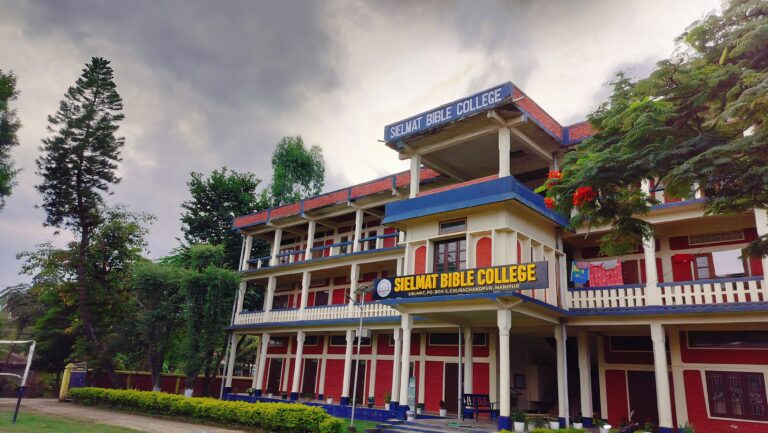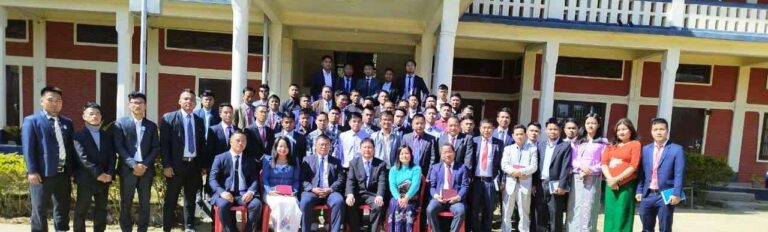
A last-minute shift to online delivery could not dampen the scholarly energy as the entire faculty of Sielmat Bible College convened for two days of curricular renewal.
April 16–17, 2026 | Sielmat Bible College | Academics
Plans, as any seasoned educator knows, are written in pencil. When Dr. Biren Kumar Nayak, Assistant Regional Secretary of ATA India, was unable to make the journey to Sielmat in person — his tickets confirmed, his itinerary set — the team did what resilient institutions do: they adapted. The two-day Curriculum Revision Workshop, scheduled for April 16–17, 2026, moved seamlessly into the online mode, and not a session was lost.
What followed over the course of those two days was a rigorous, thoughtful, and at times quietly transformative engagement with the question that sits at the heart of theological education: Is what we are teaching still shaping who we need to be shaping?
“A curriculum that is never revisited is a curriculum that has quietly stopped serving its students.”
Under the expert guidance of Dr. Nayak, the workshop opened with a foundational inquiry — Why revise? — dismantling the comfortable assumption that existing syllabi are sufficient simply because they are familiar. Participants were invited to examine the expectations and assumptions that curricula carry, often invisibly, and to interrogate whether those assumptions still hold.
Workshop sessions
- 01 Expectations & Assumptions — Curriculum: Why Revision?
- 02 Preparing for Curriculum Revision
- 03 Vision and Mission Guides the Curriculum
- 04 Graduate Profile Shapes the Curriculum
- 05 Syllabi Writing and Course Description
- 06 Syllabi Writing and Course Objective
- 07 Syllabi Writing and Course Requirement
- 08 Syllabi Writing and Course Assessment
The sessions moved with a clear architecture. The early discussions anchored curriculum revision in the institution’s own stated vision and mission — a critical reminder that academic planning is never merely administrative. It is, at its best, an act of institutional self-definition. Who are we? Who do we intend to send into the world? What must they know, embody, and be able to do?
From these lofty but necessary questions, the workshop descended productively into the craft of syllabi writing — a domain that can appear mechanical but is in fact deeply consequential. Sessions on course descriptions, objectives, requirements, and assessment methods gave faculty concrete tools to translate vision into verifiable learning outcomes. The graduate profile, Dr. Nayak emphasized, is not a marketing document — it is a compass, and every course must point toward it.
The graduate profile is not a marketing document. It is a compass, and every course must point toward it.
The two days workshop will conclude today with an evaluation and feedback session — a fitting close that modelled what good curriculum itself should do: pause, assess, and ask how things might be done better. The entire faculty of Sielmat Bible College participated, making the workshop not merely a training event but a shared institutional moment.
That the workshop ran entirely online, smoothly and productively, was itself a quiet testimony to the college’s flexibility and Dr. Nayak’s capable facilitation across the digital medium. The unavoidable became the unremarkable. And the work got done.
As Sielmat Bible College continues its commitment to academic excellence and theological formation, this workshop represents a meaningful investment — not in paperwork or compliance, but in the quality and coherence of everything that happens inside the classroom.